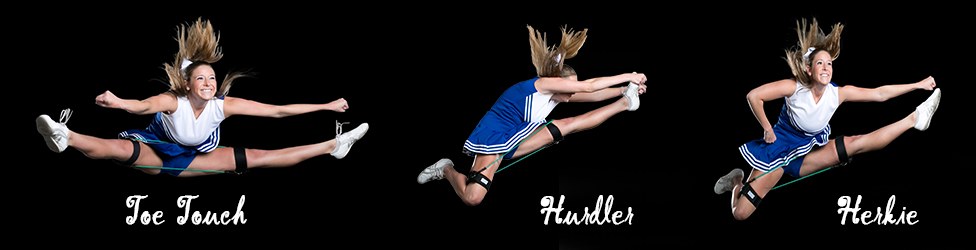
Cheerleading jumps are athletic, coordinated movements—commonly toe touches, herkies, pikes, and tucks—designed to showcase flexibility, power, and sharp motions.
They require intense core strength, leg power, and proper technique, including a precise approach (prep), maximum height, and safe, sharp landings.
Common Types of Jumps
Toe Touch: The most common jump, where legs are in a straddle position, toes pointed, and arms in a 'T' motion.
Herkie: Named after Lawrence Herkimer, one leg is straight to the side, while the other is bent inward.
Pike: Both legs are held straight out in front, parallel to the ground, with arms in a touchdown or reaching motion.
Hurdler: Involves kicking one straight leg toward the chest while bending the other behind, resembling a track hurdler, with arms in a high touchdown or V-motion
Spread Eagle: Legs are straight out to the sides in a 'V' shape, similar to a jump in figure skating.
Tips for Improvement
Flexibility: Regular stretching, especially of the hamstrings and hips, is necessary to get legs higher.
Strength: Utilize exercises like leg explosions, sitting toe touches, and core work to increase height.
Avoid Mistakes: Do not double bounce before the jump, keep your chest up, and ensure you are not bending your arms during the swing.